

The Mystery of the "Exploding" Balcony Tiles: A Cascais Case Study

In this property case study, we investigate the installation and movement mechanisms behind a dramatic balcony tile failure in Cascais. Uncovering the mystery behind so-called “exploding” balcony tiles required looking beyond the timing of the heavy rain and investigating whether moisture, waterproofing failure or movement within the tiled surface was responsible.
The incident happened shortly after a period of heavy, driving rain, so the owners naturally suspected that the storm had caused the damage. They were concerned about possible water ingress, drainage problems or an underlying issue with the balcony structure.
When property damage appears suddenly, however, the timing of an event does not necessarily reveal its underlying cause. A professional diagnostic assessment looks at the available evidence, considers the possible causes and works to identify what is actually happening before unnecessary repairs are undertaken.
In this case, tile tenting occurred due to the lack of expansion joints combined with repeated thermal expansion and contraction. As the tiles heated up, they expanded.
With no flexible joints to accommodate this movement, pressure built within the tiled surface until the weakened adhesive bond could no longer hold the tiles down.

The Diagnostic Process: Ruling Out the Usual Suspects
During the initial visual inspection, one critical installation detail stood out: there were no expansion joints within the tiled area. However, this alone was not enough to reach a conclusion. The owners were concerned about structural failure, water ingress and drainage problems, so these possibilities also needed to be investigated.
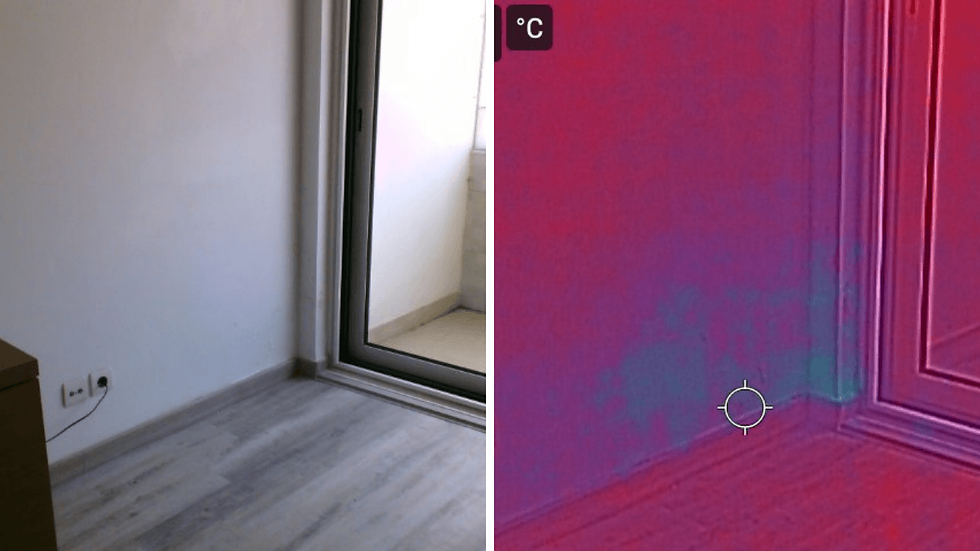
The membrane beneath the popped tiles was examined and the waterproofing was found to be intact. To check for a hidden moisture issue, active leak, or drainage failure within the concrete slab, the entire balcony floor was then scanned using a high-resolution thermal imaging camera.
The thermal signature across the balcony was even, with no cold spots or thermal anomalies indicating trapped moisture. The inspection confirmed that the structure was sound, the drainage was functioning as designed and the waterproofing was uncompromised.
So why did a 16-year-old tiled floor suddenly lift?
The answer lay in thermal expansion and the absence of expansion joints.
The Science of "Tenting": Why Tiles Pop
Tiles, adhesive mortar and the concrete slab beneath them expand when heated and contract as temperatures fall. On an exposed balcony, particularly along areas receiving intense direct sunlight, these materials can experience repeated cycles of heating and rapid cooling.
Expansion joints provide the necessary space for this movement. In this particular balcony, there were no expansion joints, meaning the expanding tiles had nowhere to move and were forced against one another as temperatures changed.
For approximately 16 years, the tiles repeatedly expanded and contracted. Over time, this persistent movement weakened the bond between the tiles, adhesive and underlying surface.
Eventually, the lateral pressure between the tightly packed tiles became greater than the weakened adhesive bond holding them in place. When a sudden temperature change occurred—in this case, following heavy storm water hitting the heated balcony surface—the materials shifted and contracted at different rates.
The built-up pressure had to release, and with no room for lateral movement, the tiles lifted upwards, creating the characteristic tent-like formation known as tile tenting. The failure can happen suddenly and may be accompanied by a loud cracking or popping sound, giving the impression that the tiles have “exploded”.
When an Exploding Balcony Tile Inspection Reveals the Need for Replacement
The heavy rain didn't wash the tiles away, but the sudden temperature drop from the storm was the final straw for an installation that had been under immense physical pressure for over a decade and a half. In this instance, the extent of the failure meant that simple patching was not an option. Further tiles were already compromised and at risk of popping. Because the original tiles are likely discontinued, a full-scale replacement is required to restore both safety and aesthetics.
By commissioning a balcony tile inspection first, the owners learned that the new installation must include proper expansion joints to prevent the same problem from occurring again. This case is a reminder of why correct installation details matter and why identifying the cause of sudden property damage before beginning repairs can prevent unnecessary work and expense.
If you are dealing with sudden property damage, an independent property assessment can help establish the cause and clarify what repairs may actually be required.
Frequently Asked Questions
Why do floor tiles pop up or "tent" suddenly?
Tile tenting almost always occurs due to a lack of expansion joints combined with thermal expansion. As tiles heat up, they expand. If there are no flexible joints to absorb this growth, the tiles press against each other until the pressure breaks the adhesive bond, forcing the tiles upward.
Did the heavy rain cause my balcony tiles to crack and lift?
Heavy rain is often a trigger, but rarely the root cause. When hot, sun-baked tiles are suddenly hit by cold storm water, the rapid temperature drop causes materials to shift quickly. If the adhesive is already weakened from years of thermal stress, this sudden shift causes the tiles to pop.
How can I tell if my balcony has hidden water damage beneath the tiles?
Visual inspection alone may not reveal moisture trapped beneath a tiled surface. During a professional diagnostic assessment, thermal imaging can help identify temperature anomalies that may indicate areas requiring further moisture investigation. Additional testing may also be used where appropriate to build a clearer picture of what is happening beneath the surface.
Who should I call when property damage like this occurs?
An independent diagnostic property assessment can help establish the likely root cause before repair work begins. This provides property owners with clearer information about the problem and the repairs that may actually be required.



Comments