

Why Does Cooking Cause Condensation in Homes in Cascais?

If your windows steam up when you cook, or you notice dampness and mould appearing around the kitchen, it is easy to assume there is a plumbing or roof leak. While that is sometimes the case, everyday cooking can also introduce a surprising amount of moisture into a home.
Understanding how cooking condensation develops helps homeowners recognise when normal kitchen activity is becoming a persistent moisture problem. This can be particularly noticeable in Cascais homes during cooler months.
Older properties may have colder internal surfaces, limited insulation and less effective ventilation. Renovated properties can also experience changes in moisture behaviour when modern windows or insulation make the building more airtight.
For homeowners, expats and buyers in Cascais, understanding how cooking moisture behaves can help distinguish everyday condensation from a moisture problem that requires further investigation.
What Causes Cooking Condensation in Cascais?
Cooking releases water vapour into the air. Boiling water, simmering food, frying and washing dishes with hot water can all increase indoor humidity.
When warm, humid air comes into contact with a colder surface, such as a window pane, external wall or tiled splashback, it cools and can form liquid water droplets. This is condensation.
In Cascais properties, coastal conditions combined with older construction, limited thermal insulation or colder areas of the building can affect how quickly moisture forms and dries.
The issue is rarely cooking itself. Problems arise when the moisture produced during everyday meal preparation is not removed effectively.
Why Do My Windows Steam Up When I Cook?
Kitchen glass is often colder than the surrounding indoor air. As warm, moist air generated during cooking reaches the glass, it cools and forms droplets on the interior surface.
A small amount of condensation during heavy cooking is not necessarily a concern. However, if windows regularly become heavily misted or water begins collecting on the glass and frames, moisture may be accumulating faster than it is being removed.
If these surfaces remain damp for prolonged periods, the surrounding area can become more susceptible to mould.
Can Cooking Moisture Cause Damp and Mould?
Yes. Repeated condensation can keep surfaces damp for long enough for mould to develop, even when there is no plumbing or roof leak.
Kitchens can be particularly vulnerable because moisture is produced regularly, while cupboards, appliances and fitted units can restrict air circulation.
However, mould should not automatically be attributed to cooking. Plumbing leaks, water ingress, poor insulation and other moisture problems can produce similar symptoms.
If mould repeatedly returns after cleaning, the important question is why the area remains damp. Scrubbing or repainting the surface will not resolve the underlying problem if the source of moisture has not been identified.
Why Does Mould Appear Behind Kitchen Cabinets?
The space behind fitted kitchen cabinetry can be difficult to ventilate and easy to overlook. When a cabinet is positioned against a cold external wall, warm indoor air can reach the area while air movement remains limited.
Persistent moisture can then create conditions where mould develops unnoticed until staining, mould growth or a musty smell becomes apparent.
For property buyers, this is an important consideration because attractive kitchen finishes do not necessarily reveal the condition of the wall behind them. Recurring mould in the same enclosed area is a reason to investigate the cause rather than repeatedly clean the surface.
Is It Condensation or a Leak?

Distinguishing between condensation and a leak is important because the appropriate solution depends on the source of the moisture.
Condensation is generally associated with cold surfaces and may become more noticeable during activities that increase indoor humidity, such as cooking or bathing. A leak may create a more localised or persistent area of moisture, although the pattern depends on where water is entering and how it travels through the building.
Visible signs such as staining, peeling paint or mould are not enough on their own to establish the cause.
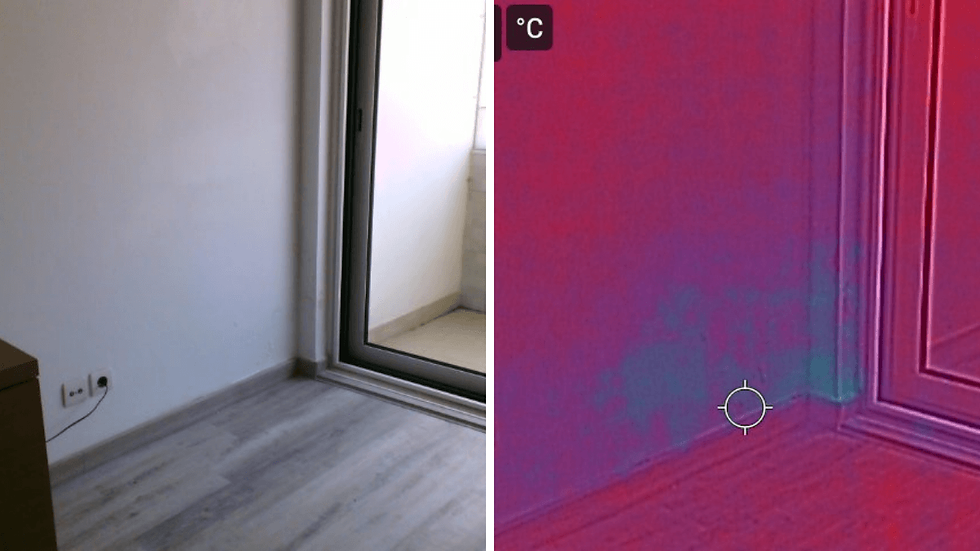
Where the source is unclear, diagnostic equipment such as thermal imaging cameras and moisture meters can help identify areas requiring closer investigation. A proper diagnosis should come before deciding how the problem needs to be treated.
Why Doesn't an Extractor Hood Always Solve the Problem?
An extractor hood can help remove moisture, but its effectiveness depends on how the system operates.
A hood that vents directly to the outside can remove humid air from the kitchen. A recirculating hood, however, passes air through filters before returning it to the room. This can help reduce cooking odours and grease, but it does not remove the water vapour produced during cooking.
This can become particularly relevant in modern, tightly sealed homes where there is less natural air movement. If the extraction system is inadequate, moisture can remain in the kitchen and contribute to persistent condensation.
How Can You Reduce Kitchen Moisture?
Simple changes can help reduce the amount of moisture that remains in the kitchen.
Using an extractor that vents outdoors where possible, keeping lids on pots and pans while cooking and ventilating the kitchen during and after meal preparation can all help remove excess moisture.
It is also worth considering the home's overall moisture load. Drying laundry indoors, showering and other everyday activities can add significant moisture to the air. When several sources occur in the same home, condensation can become more persistent.
If moisture problems continue despite reasonable ventilation and moisture control, the building itself may require closer investigation.
Why Should Buyers in Cascais Check Kitchen Moisture?
During a brief property viewing, particularly in warm and dry weather, signs of historic condensation or hidden dampness can be easy to miss.
This is especially relevant when viewing older properties or recently renovated homes, where ventilation, insulation and moisture behaviour may not be immediately obvious.
An independent property inspection looks beyond cosmetic finishes and considers factors such as ventilation, insulation, external walls and accessible plumbing. Diagnostic equipment can also be used where appropriate to investigate areas showing signs of unusual moisture or temperature patterns.
For buyers in Cascais, this can provide a clearer understanding of the property's condition before committing to the purchase.
Frequently Asked Questions
Can cooking cause condensation on windows?
Yes. Cooking releases water vapour into the air. When warm, humid air reaches a colder window, the vapour can condense into water droplets. Occasional condensation is normal, but persistent moisture may indicate inadequate ventilation or another underlying issue.
How can I tell if kitchen damp is caused by condensation or a leak?
Condensation is often associated with cold surfaces and periods of increased indoor humidity, such as when cooking. A leak may produce more localised or persistent moisture. However, visible staining or mould alone cannot confirm the cause. Moisture measurements, thermal imaging and a physical inspection may be needed to investigate further.
Can cooking condensation cause mould?
Yes. If condensation repeatedly leaves surfaces damp, it can create conditions that allow mould to develop. However, recurring mould should not automatically be blamed on cooking, as plumbing leaks, water ingress, poor insulation and other moisture problems can produce similar symptoms.
How can I reduce condensation when cooking?
Use an extractor that vents outdoors where possible, keep lids on pans, ventilate the kitchen during and after cooking, and avoid allowing steam to spread throughout the home. If condensation continues despite these measures, you may need to investigate the underlying cause further.
Should I check for moisture before buying a property in Cascais?
Yes. Persistent condensation, damp or mould can sometimes indicate issues with ventilation, insulation, water ingress or other building defects. An independent property inspection can help identify signs that may not be obvious during a normal viewing.



Comments