

Poorly Sealed Windows: Moisture Problems in Portugal

Updated: Sep 23
Your windows may look perfectly sealed, but appearances can be deceptive. Many window moisture problems in Portugal begin around gaps and joints that appear completely watertight.
These problems often develop long before you notice damp patches, peeling paint, or mould around your windows. In many cases, moisture is slowly finding its way into the surrounding wall while the window itself appears to be properly sealed.
If you look closely at the aluminium windows in your Portuguese home, you'll usually see a neat bead of silicone sealing the gap between the frame and the wall. It looks professional and watertight, but the real weakness often lies beneath or alongside the sealant rather than through it.
Understanding how moisture enters around window frames is the first step towards identifying the true cause of window moisture problems in Portugal and preventing more serious damage to your property.
The Role of Cement Render
Around most window frames, the surrounding wall is finished with cement render. Cement render is naturally porous, meaning it can absorb water over time. The only thing protecting it from rain penetration is the exterior paint or façade coating system applied over it. As long as that coating remains continuous and intact, the system usually performs well.
However, silicone creates a hidden weakness in that system. Because silicone cannot normally be painted properly, the exterior coating stops at the edge of the silicone bead. Over time, the paint can pull away slightly or leave a fine transition line where water begins to penetrate. The silicone itself may still be perfectly watertight, but moisture can track around it and into the exposed render beside the frame. This is where many moisture problems around windows begin.

Why Window Moisture Problems Are Worse on Solid Walls in Cascais
Solid Walls vs. Cavity Walls: How They Differ
The Structure:
Cavity Wall: Features an outer layer, an internal cavity, and an inner layer.
Solid Wall (Common in Portugal): A single, thick barrier of solid masonry with no internal gap.
The Moisture Strategy:
Cavity Wall: Relies on the cavity for drainage. Water drains away before reaching the interior.
Solid Wall: The wall itself must resist all water penetration from the outside.
The Risk Factor:
Cavity Wall: High tolerance for minor external sealant failures.
Solid Wall: Zero tolerance. If water gets past the exterior face, it migrates directly indoors.
Common Signs of Window Moisture Problems in Portugal
Common signs include damp patches, peeling paint, mould growth, staining, and bubbling plaster around the window frame. These symptoms often develop gradually and may indicate that moisture has been entering the surrounding wall for some time rather than being caused by condensation alone.
How Poor Sealing Causes Moisture Problems Around Windows
One of the most misunderstood aspects of window leaks and moisture problems in Portugal is how easily they contribute to issues inside homes. When moisture repeatedly enters around a window frame, the surrounding wall materials remain damp for extended periods. Even small amounts of trapped moisture can slowly raise humidity levels within the wall structure and internal finishes.
Why Mould Forms Around Window Frames
Mould develops when moisture, organic material, and limited airflow are present together. Around windows, these conditions often occur when moisture becomes trapped within the surrounding wall or finishes, creating an environment where mould can establish and continue to grow.
Common Areas Where Mould Appears
When moisture intrusion occurs around a window, mould is most commonly found in the corners of window reveals, behind curtains, along the reveals themselves, and around the silicone edges where moisture tends to remain trapped for longer periods.
In many cases, homeowners assume the mould is caused purely by condensation. While condensation can contribute, hidden moisture ingress around windows is a major underlying cause of window moisture problems in Portugal. This is especially common in coastal areas such as Cascais, Estoril, and Lisbon, where buildings are regularly exposed to wind-driven rain and high humidity.
Why Silicone Often Appears to Be Working
One reason these problems are frequently misdiagnosed is that the silicone joint itself often still looks perfect. There may be no visible cracks, obvious gaps, failed sealant, or direct path for water to pass through the silicone.
The failure usually occurs beside the silicone rather than through it. This creates the impression that the window is properly sealed when moisture is actually tracking into the porous render surrounding the frame.
The Correct Way to Fix Window Moisture Problems in Portugal
The solution is not simply to apply more silicone. The entire perimeter of the window needs to be treated as part of the building's external waterproofing system.
The objective is to create a continuous water-resistant barrier between the wall coating, the joint, and the window frame, preventing moisture from entering through vulnerable transition points.
This is where paintable façade sealants become important. Products such as SikaHyflex-250 Facade are designed specifically for façade joints and external building envelopes. Unlike standard silicone, these products can bond properly to both aluminium frames and cement-based render while also being paintable.
This creates a continuous waterproofing system by allowing the exterior coating to continue across the joint, improving adhesion between different materials, eliminating vulnerable transition edges, and providing better long-term resistance to moisture penetration.
In exposed areas such as window sills and reveals, additional protection can also be added using cementitious waterproofing products such as Cemflex before final finishing. These systems help reduce water absorption into the substrate and support the overall façade waterproofing system.
Why Professional Home Inspections Matter
Many window moisture problems in Portugal are only discovered during a professional inspection. Areas around the windows are assessed for early moisture intrusion, hidden damp within wall finishes, poor sealing details, cold bridging, elevated moisture readings, and the early signs of mould development.
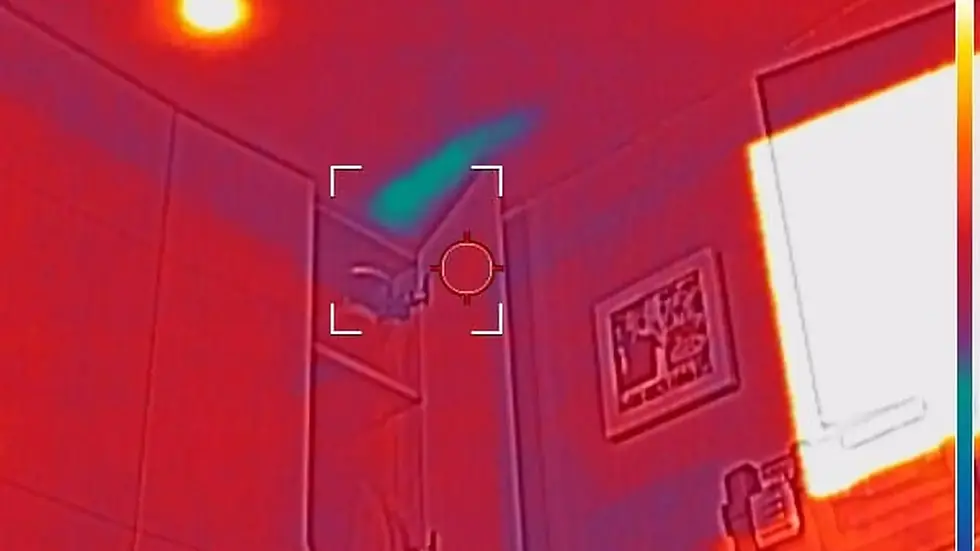
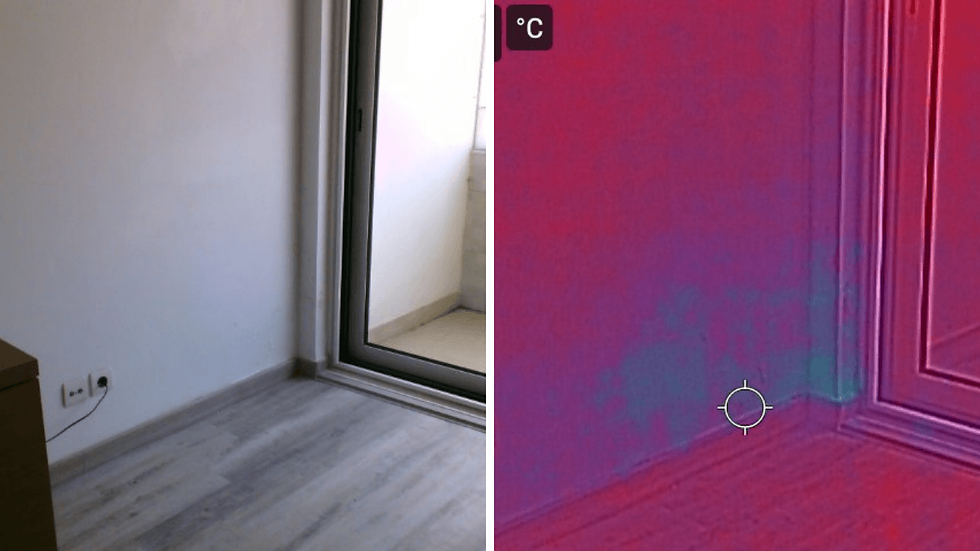
Tools such as thermal imaging and moisture meters can often identify hidden moisture problems that are not yet visible to the naked eye. This is especially important in older properties and coastal homes in Cascais, Estoril, and Lisbon, where long-term exposure to wind-driven rain and humidity can slowly affect solid wall construction over time.
Identifying these issues before visible damage develops can help prevent expensive repairs, structural deterioration, persistent mould problems, damage to internal finishes, and ongoing indoor air quality concerns.
Signs Your Windows May Not Be Properly Sealed
Common warning signs include damp patches below windows, peeling paint around the frames, mould forming on the reveals, bubbling plaster, musty odours near the windows, cold or persistently damp wall surfaces, and discoloured corners around the frames.
These symptoms are often blamed solely on condensation, even though the real issue may be moisture ingress through the external window perimeter.
Final Thoughts
A single defect rarely causes moisture problems in windows in Portugal. They happen because the waterproofing system around the window is incomplete. Standard silicone may seal the immediate gap, but on solid masonry walls common in Portugal, that alone is often not enough. Long-term performance depends on creating a continuous façade system in which the wall coating, sealant, and window frame work together to resist water penetration. When that continuity fails, moisture can slowly enter the wall structure, leading not only to damp damage but also to hidden mould growth inside the home.



Comments