

Buying Property in Cascais: Look Beyond Fresh Paint

Updated: Sep 23

The walls are spotless, the ceilings are bright, and the whole property looks as though it has just been finished. But if you're buying property in Cascais, could that fresh coat of paint be hiding something you haven't noticed yet?
Freshly painted walls and clean finishes create an excellent first impression, and often there is nothing more to it than routine maintenance. But paint can also make previous staining, repairs or other signs of a problem much harder to spot.
So, should fresh paint concern you when viewing a property? Not necessarily. The important question is why the property was repainted and whether anything beneath that fresh finish deserves a closer look.
Why Is a Property Often Repainted Before Sale?
There are plenty of perfectly legitimate reasons to repaint a property before selling it. A fresh coat of paint brightens tired rooms, covers everyday scuff marks and helps buyers imagine themselves living in the space. It is one of the simplest and most cost-effective ways to improve a property's presentation, and many homeowners choose neutral colours because they appeal to the widest range of buyers.
Repainting is often no different from tidying the garden or replacing worn fittings. It forms part of preparing a property for viewings and doesn't necessarily indicate that anything is wrong.
The difficulty is that paint changes appearance, not condition. It improves what you can see, but it cannot tell you what may have happened to the building over the years.
Why Fresh Paint Matters When Buying Property in Cascais
Cascais' coastal climate presents challenges that many overseas buyers may be unfamiliar with. Properties along the coast, including in Cascais and Lisbon, are exposed to Atlantic winds, salt-laden air and periods of heavy winter rain.
These conditions mean that regular maintenance, including exterior painting, plays an important role in protecting a property's exterior over time. Inland homes face different challenges, but moisture, condensation, and changing temperatures affect properties throughout the country.
Many traditional Portuguese homes use construction methods and materials that differ from those found in newer properties. Stone walls, rendered façades, tiled roofs and older building materials can all respond differently to moisture and weather. None of this should discourage buyers, but it does mean that homes require ongoing maintenance throughout their lives.
It is therefore quite common for areas that have been repaired or redecorated to receive a fresh coat of paint, whether as part of routine maintenance or following a leak or moisture problem. The paint itself, however, doesn't tell you which of those situations applies.
What can fresh paint make harder to recognise?
Fresh paint doesn't create hidden defects, but it can make the visible signs of previous problems much less obvious.
A ceiling that once showed water staining may look as good as new after being redecorated. Hairline cracks can become difficult to see, while walls affected by condensation or mould may appear clean after treatment and repainting. Areas where plaster has been repaired often blend seamlessly into the surrounding finish, making it difficult for buyers to know whether they are looking at routine maintenance or evidence of a previous issue.
In some cases, visible mould has been cleaned and painted over, but if the underlying moisture problem hasn't been fully resolved, microscopic mould spores may still be present in household dust. Where there are concerns about a property's history of damp, recurring mould, or indoor air quality, ERMI mould testing can provide additional insight by analysing dust samples for mould species commonly associated with water-damaged buildings.
While this level of testing isn't necessary for every property purchase, it can be useful where there are concerns about a property's history of damp, recurring mould or indoor air quality.
What should buyers look for during a viewing?
Rather than becoming suspicious of every freshly painted room, it's better to become curious about the property as a whole.
If one ceiling appears noticeably newer than the rest of the house, it is worth asking why. If only one wall has recently been painted while adjoining walls show normal signs of age, ask whether any repairs were carried out. Small differences in texture, plaster finish, or paint sheen can sometimes indicate previous maintenance work, although they are not, on their own, evidence of a defect.
Using your senses can also help. A faint musty smell, condensation on windows, or bubbling paint can be a reason to investigate whether moisture is present. Equally, you may find nothing unusual at all. The aim isn't to search for problems where none exist, but to understand the property's history before committing.
Why is a visual inspection not always enough?
One of the challenges when buying property is that many issues cannot be identified by appearance alone.
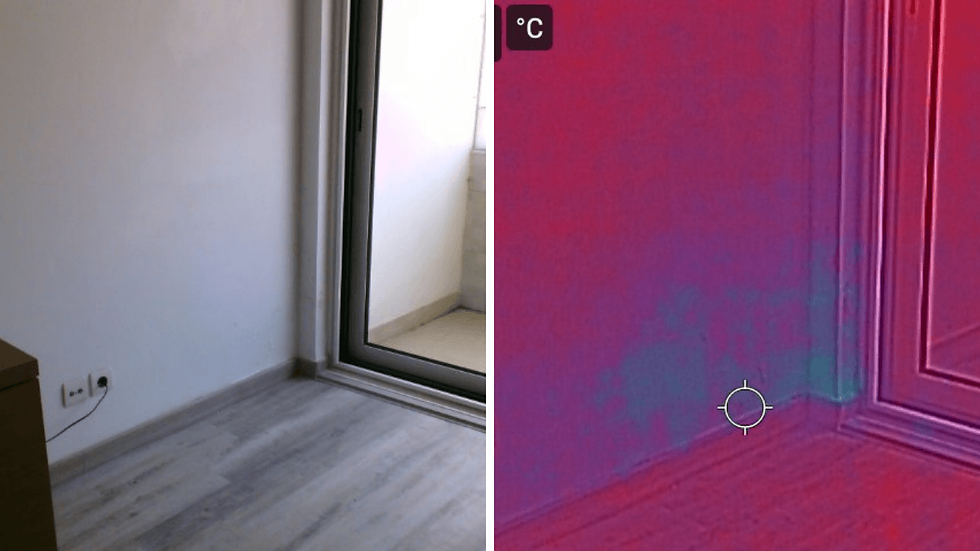
Moisture can remain trapped behind plaster long after a wall has been repainted. Small roof defects may not become obvious until the first heavy winter storms arrive. Insulation gaps, hidden leaks, and areas affected by damp often leave very little visible evidence during a standard viewing.
This is one reason an independent property inspection can provide useful information before a purchase is completed. Visual observations can be supported by moisture testing, while thermal imaging helps identify temperature differences that may indicate hidden moisture, insulation defects, or areas requiring further investigation. Where appropriate, drone roof inspections can also assess areas that are difficult to view safely from ground level.
These tools don't replace experience, but they do provide a much clearer understanding of the property's overall condition than appearance alone.

Looking beyond the paint
One of the reasons people fall in love with Portugal is the variety of homes available, from apartments overlooking the coast in Cascais to traditional village houses and contemporary family villas. Every property has its own character, and every property has its own maintenance history.
Fresh paint is often nothing more than a finishing touch before welcoming a new owner. Occasionally, it encourages buyers to ask a few more questions and look beyond the surface.
Buying a home is one of the biggest investments most people will ever make. Taking the time to understand the condition of the property—not just how it presents on the day of a viewing—can help you make that decision with confidence.
At AllProperty Inspections, we regularly inspect homes across Cascais and the surrounding area, helping buyers understand what cannot always be seen during a property viewing. By combining a detailed visual assessment with thermal imaging, moisture testing, drone roof inspections, and, where appropriate, ERMI mould testing, we provide independent information that helps buyers make informed decisions before committing to a purchase.



Comments